

Podcast: Damiano Brigo on derivatives, AI, machine learning and more
Genuine artificial intelligence remains "very, very far away", says Imperial College's Brigo
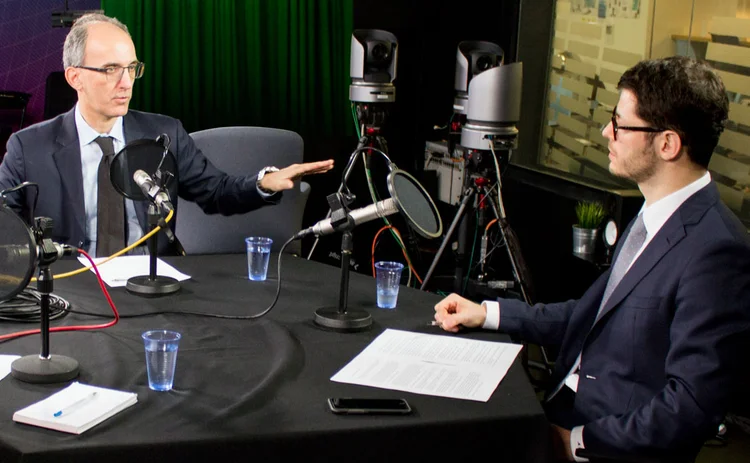

In February, we welcome professor Damiano Brigo, chair of mathematical finance at Imperial College London, as an occasional Risk.net columnist. For this podcast – the first of a monthly series – Brigo visited our office to share his thoughts on the lost causes, current role and future prospects of quantitative finance.
The derivatives market, he says, “has moved from having complex payoffs in a simple system on to simple payoffs in a complex system”, and the models needed in this new environment are still being studied. Elsewhere, quants’ expertise is being applied in a number of newer areas such as risk optimisation, development of machine learning algorithms or analysis of the impact of central clearing on markets.
Brigo sees machine learning and data science having a big impact in finance, but is sceptical of the near-term prospects for artificial intelligence: “We are still very far from a real intelligence and human-like thinking,” he says. Rather, voice recognition, chess and other game-playing applications, or interactive software that is able to answer questions, are simply examples of sophisticated statistical algorithms.
He also explains how the UK government’s plan to change its funding policy for academic research will incentivise projects that have more of an impact on society.
To hear the full interview, listen in the player above, or download. Future podcasts in our Quantcast series will be uploaded to Risk.net. You can also visit the main page here to access all tracks or visit the iTunes store.
Further reading
Only users who have a paid subscription or are part of a corporate subscription are able to print or copy content.
To access these options, along with all other subscription benefits, please contact info@risk.net or view our subscription options here: http://subscriptions.risk.net/subscribe
You are currently unable to print this content. Please contact info@risk.net to find out more.
You are currently unable to copy this content. Please contact info@risk.net to find out more.
Copyright Infopro Digital Limited. All rights reserved.
As outlined in our terms and conditions, https://www.infopro-digital.com/terms-and-conditions/subscriptions/ (point 2.4), printing is limited to a single copy.
If you would like to purchase additional rights please email info@risk.net
Copyright Infopro Digital Limited. All rights reserved.
You may share this content using our article tools. As outlined in our terms and conditions, https://www.infopro-digital.com/terms-and-conditions/subscriptions/ (clause 2.4), an Authorised User may only make one copy of the materials for their own personal use. You must also comply with the restrictions in clause 2.5.
If you would like to purchase additional rights please email info@risk.net
More on Markets
Banks eye cost cuts ahead of RateStream Treasuries push
FX SpotStream’s move into rates seen as both fee-saver and potential boost to streaming execution

Real money investors cash in as dispersion nears record levels
Implied spreads were elevated to start 2026. Realised levels have been “almost unprecedented”

JP Morgan gives corporates an FX blockchain boost
Kinexys digital platform speeds cross-currency, cross-entity client payments

China eases cross-border grip in new derivatives rules
Lawyers hail return to a “more orthodox territorial approach” to regulating the market

Fannie, Freddie mortgage buying unlikely to drive rates
Adding $200 billion of MBSs in a $9 trillion market won’t revive old hedging footprint

Market-makers seek answers about CME’s cloud move
Silence on data centre changes fuels speculation over how new matching engine will handle orders

Neural networks unleashed: joint SPX/VIX calibration has never been faster
SPX and VIX options can be jointly calibrated in real time with deep neural networks

Ardagh CDS outcome satisfies some, but presents more questions
Early restructuring trigger and asset-package delivery could signify a new era for European trades
