Hedge fund due diligence process considers myriad aspects of qualitative and quantitative factors
How to analyse the myriad of data collected during the due diligence process has led many companies to try to establish methods of quantifying and measuring some or all of the resulting information.

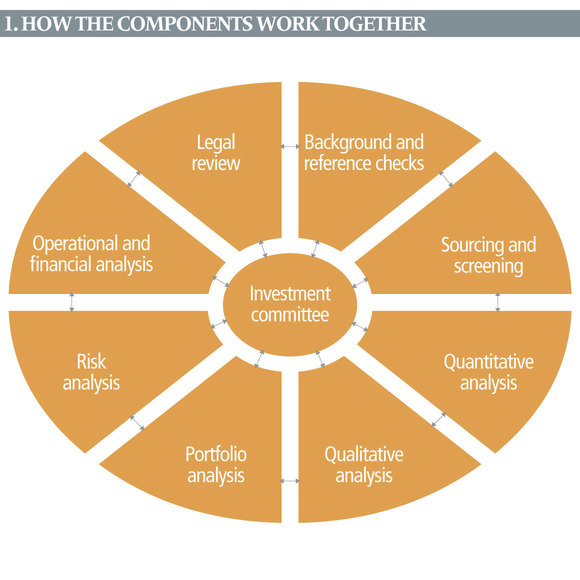
The process of analysing hedge fund managers involves many steps. While most companies that conduct hedge fund due diligence have their own unique procedures and policies, each generally integrates eight broad categories (including a brief sampling of the specific review items in each).
The first is sourcing and screening where managers can be sourced from a variety of places including databases, service providers, other hedge fund managers as well as funds screened based on strategy, risk/return parameters, geography, market cap, liquidity, fees and other criteria.
A quantitative analysis screen is based on performance, volatility or ratios that combine the two such as Sharpe ratio, downside deviation, alpha versus beta and correlation.
A qualitative analysis includes such things as an investment professional’s skill, the fund’s edge, team dynamic, team pedigrees, references and short alpha.
Portfolio analysis includes such things as exposure analysis, attribution, long book versus short book, liquidity analysis and style drift.
Risk analysis covers factor analysis, quality of risk metrics, skew and kurtosis, stress testing and scenario analysis.
Independent valuation, independent administration, appropriate service providers and multiple signatories to move cash are covered under operational analysis.
Financial analysis includes a review of audited financial statements as well as an expense review.
Legal analysis covers reviewing all company and fund documents including memorandums, subscription forms, articles of incorporation and other relevant papers as well as the appropriate compliance procedures and determination of the effectiveness of the chief compliance officer.
References and background checks cover all key employees including references with former colleagues and clients and all historical data and statements.
Graphic 1 shows how the different components can work together. The due diligence process is not linear: step one leads to step two and so on. Rather it tends to be dynamic with all of the information obtained fed into a central location for review and consideration, typically by a company’s investment committee or board of directors.
The due diligence process is an exhaustive one that can typically take from three to six months and more than a year in extreme cases. The question of how to analyse the myriad of data collected during this process has led many companies to try to establish methods of quantifying and measuring some or all of the resulting information. These scoring models represent an attempt to quantify all of the variables reviewed and assessed, weighting them according to their importance and relevance.
Scoring models have been around for many decades. They can be useful in hedge fund evaluations because they can provide:
Consistency: forcing the reviewer to think about all the hedge funds under review in a similar context.
Attribution: each variable in a scoring model can be aggregated to a broad level (investment, operations, risk) allowing for multi-dimensional analysis.
Tracking: once a hedge fund has a score, it is easy to update on a regular basis. This allows the reviewer to track the score and monitor for changes over time.
Peer analysis: once a group of funds have been scored, the reviewer can look for trends within the various strategies or look for inconsistencies.
Apportioning/weighting: scoring models give the reviewer the ability to emphasise those attributes that they deem to be the most relevant when evaluating hedge funds and de-emphasise those attributes that they deem to be less important.
Scoring models can be useful but not in absolute terms. A fund with a slightly higher score is not necessarily a better fund. Scoring models take on the biases of their creators and, as such, should be used as just another one of the many tools at the due diligence analyst’s disposal.
Some of the potential issues with scoring models are:
Structure: The model itself may be structurally flawed due to bias (weighting) toward or against certain factors. The structural biases can result from incorrect weighting schemes or unintentional crossover among the factors. For example, structural flaws might include an unintentional bias toward or from investment philosophies that are fundamentally based versus quantitatively oriented. The bias can also be intentional, but its implications must be disseminated and fully understood by anyone using it to score managers or anyone reviewing the scoring results.
Inconsistency: There may be a lack of consensus about factor scoring and/or lack of consistent application of factor scoring. The inconsistent scoring of factors within the model can be done by one person over time, or most likely, among different people working at the same organisation.
A score must mean the same thing to everyone involved in the scoring and reviewing process or the results will be inconsistently applied and possibly misinterpreted.
Factor robustness: The model might not allow for all possible data, so some kinds of information might be forced into categories where they do not necessarily fit.
Differentiation: The final tabulated scores between managers must be offer a wide enough range of possible scores so that the analyst can adequately differentiate among good, bad, and average scores.
Although one should never hire an investment manager/product based solely on the bottom-line score created by a scoring model, the comparison of different managers’ scores should offer a strong indication as to which should not be considered at all.
This paper highlights a simple hedge fund scoring model that extracts various key elements of the process highlighted in Hedge Fund Analysis (Wiley 2012). The model employs a total of 42 variables that cover each the key areas from the three main categories: investment, operations, risk, breaking out performance as a fourth category to point out how low in the pecking order performance based measures are placed.
The model highlighted in graphic 2 is broken into four components: investment, operational, risk and performance-related. Each variable is weighted according to its level of importance. 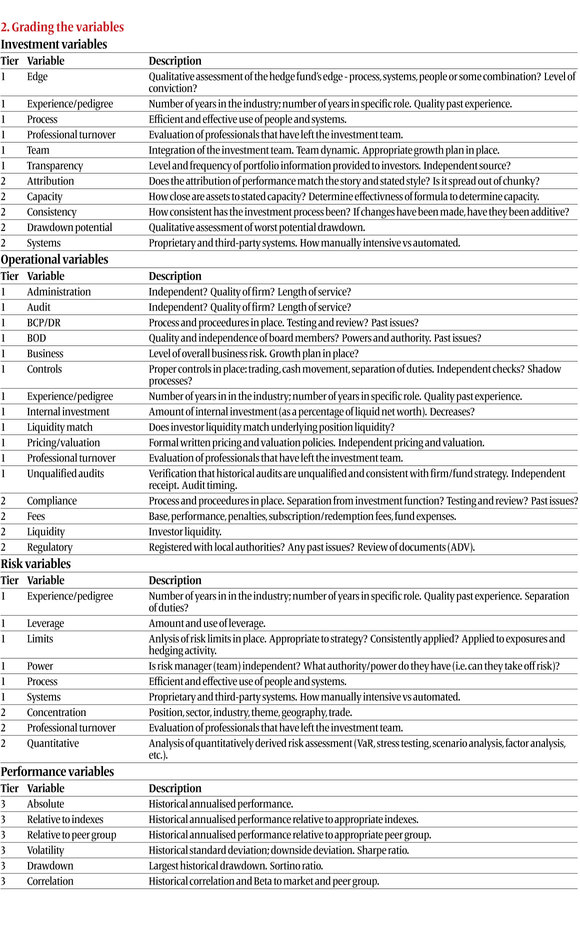
A variable that has a grade 1 is viewed as the most important and will receive a higher multiple. A variable with a grade 2 is viewed as important but not as important as variables in grade 1.
All variables in the investment, operational and risk categories receive either a grade of 1 or 2. All the variables in the performance-related category receive a grade of 3, which means they are viewed as the least important. Hedge funds should not be hired based on past performance although it should not be ignored.
Each variable is scored on a scale of -3 to +3, with -3 being the worst score and +3 being the best score. To apply the grade system, we apply the following multiples:
Grade 1: multiply by three
Grade 2: multiply by two
Grade 3: multiply by one
This simple grading system allows us to emphasise those variables that we view as the most important. Each of the four categories is scored separately and then they are aggregated to compile a total score for each manager.
It would not be possible to provide all of the details of the individual scores in this article, so I have included an example of one of the variables to provide guidance should you choose to adopt a scoring model for your own purposes.
Variable: experience/pedigree
Definition: number of years in the industry; number of years in specific role.
Quality: past experience.
Grade: 1 (so multiply score by 3)
Individual scores
3 = More than 10 years’ direct hedge fund experience in same strategy; previous track record in strategy must be independently verifiable
2 = More than 6 years’ direct hedge fund experience in same strategy; previous track record in strategy must be independently verifiable
1 = More than 3 years’ direct hedge fund experience in same strategy; previous track record in strategy must be independently verifiable
0 = Less than 3 years’ direct hedge fund experience in same strategy; previous track record in strategy must be independently verifiable
-1 = Less than 7 years’ direct hedge fund experience in similar strategy and/or more than 10 years non-hedge fund (but relevant experience such as long-only or private equity)
-2 = Less than 4 years’ direct hedge fund experience in similar strategy and/or more than 6 years non-hedge fund (but relevant experience such as long only or private equity)
-3 = no relevant experience
As the example shows, it is important for each individual score to have a specific definition that can be understood, scored and interpreted correctly. In a real-world example, each of the individual score definitions would likely include additional verbiage so that there could be no confusion as to its meaning. The process of creating these definitions alongside other investment professionals can be enlightening.
First, the process of sitting down to decide what variables should be included and how to weight them often sheds light on how different members of an investment team view the due diligence process. The conversation over what should be included and how important each item is in the scoring model helps to bring a team together and to unify the methodology employed by the firm. Second, the conversation regarding the specific definitions for each score helps to define areas of strengths and weaknesses for each of the team members.
Once we have decided on the variables to be included and set the definitions for each variable and their underlying scores, we can apply the model to actual hedge fund managers. Graphic 3 gives an example of how we can measure and review the results in absolute terms.
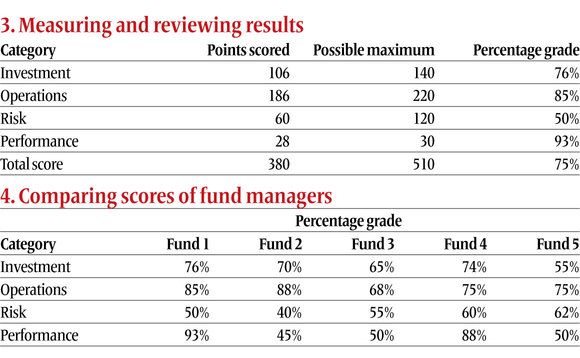
Graphic 5 illustrates how we can measure a hedge fund manager’s score over time. In this case we have graphed the historical scores for each of the four sections as well as the total score.
However, scores in absolute terms can be somewhat meaningless. You need context to really evaluate and measure a hedge fund manager’s scores at a point in time as well as over time. Graphic 4 compares the scores of five different hedge fund managers. In our example it is presumed that the funds are similar in terms of strategy (for an apples to apples comparison).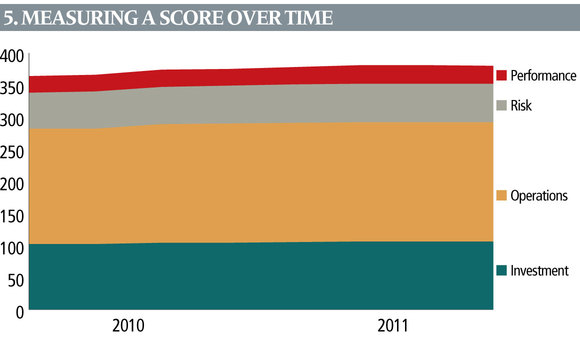
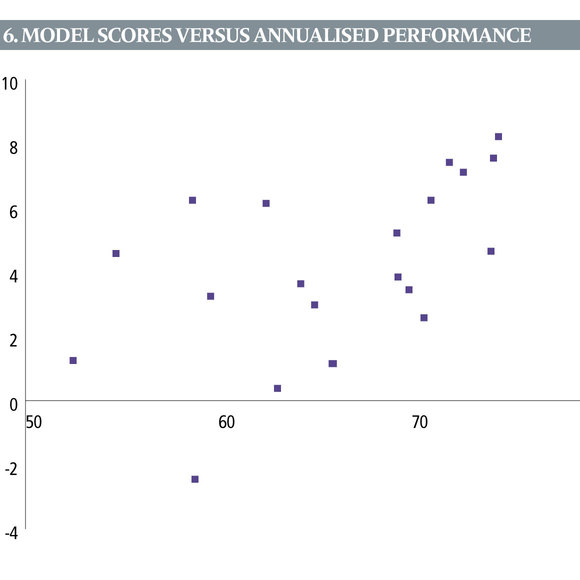
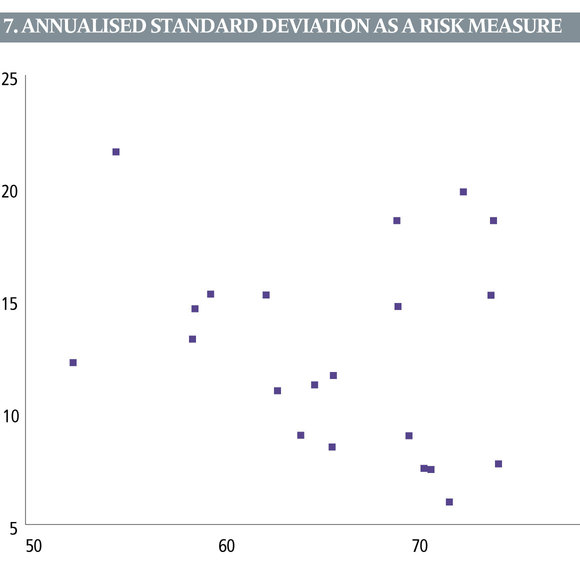
Once you have scored a number of hedge fund managers, it is possible to create dozens of unique ways of viewing the data. For example, we can look at a scatter chart that graphs hedge fund manager’s total scores against different measures of performance or risk.
Graphic 6 illustrates a how a universe of managers looks when their total model scores are graphed against annualised performance.
Graphic 7 illustrates the same universe but uses annualised standard deviation as a risk measure. While none of these charts will singly make or break an investment decision, they will add great perspective to the process.
Frank Travers, who wrote this article, is the author of Hedge Fund Analysis: an in-depth guide to evaluating return potential and assessing risks (Wiley 2012) and Investment Manager Analysis: a comprehensive guide to portfolio selection, monitoring and optimisation (Wiley 2004).
Only users who have a paid subscription or are part of a corporate subscription are able to print or copy content.
To access these options, along with all other subscription benefits, please contact info@risk.net or view our subscription options here: http://subscriptions.risk.net/subscribe
You are currently unable to print this content. Please contact info@risk.net to find out more.
You are currently unable to copy this content. Please contact info@risk.net to find out more.
Copyright Infopro Digital Limited. All rights reserved.
As outlined in our terms and conditions, https://www.infopro-digital.com/terms-and-conditions/subscriptions/ (point 2.4), printing is limited to a single copy.
If you would like to purchase additional rights please email info@risk.net
Copyright Infopro Digital Limited. All rights reserved.
You may share this content using our article tools. As outlined in our terms and conditions, https://www.infopro-digital.com/terms-and-conditions/subscriptions/ (clause 2.4), an Authorised User may only make one copy of the materials for their own personal use. You must also comply with the restrictions in clause 2.5.
If you would like to purchase additional rights please email info@risk.net
More on Investors
Asia Risk Congress 2017: Factor-based investing in emerging markets
Sponsored video: Premia Partners

Beta often is a "meaningless concept"
When correlation is low, hedge fund investors are "simply wrong" to use beta

Arden: AIFMD driving investors to alternative Ucits
Managers faced with a choice of how to operate funds going forward

USS IM cajoles hedge funds to behave better
Corporate governance initiatives gain traction with funds and investors

India steers offshore investors away from P-notes towards direct market access
Sebi tries to exert greater control over foreign investment by tightening rules governing P-note issuance and streamlining foreign investor approval process

Hedge funds play key role in Ontario Teachers’ Pension Plan
Seeing the bigger picture

Communicating portfolio risk intuitively and effectively
Visualising risk

Hedge funds can rescue pension fund industry, says Cern pension chief
Radical conservative